There are no items in your cart
Add More
Add More
| Item Details | Price | ||
|---|---|---|---|


If you are preparing for the UPSC Indian Statistical Service (ISS) exam, you know that "Official Statistics" (Paper II) and "General Economics" are the rank-deciders. But here is the challenge: the textbooks are old, but the economy is changing fast.
The Ministry of Statistics and Programme Implementation (MoSPI) is currently undertaking one of the most massive exercises in Indian history—shifting the Base Year for our economic indicators.
Why does this matter for you? Because for the ISS 2026 exam, the question paper won't just ask "What is GDP?"; it will ask "Why was 2022-23 chosen as the new base?" or "How does Double Deflation improve GVA estimates?".
In this blog, we break down everything—from the basic concepts to the expert-level debates—simplifying the "New Base Year" saga for every StatChakravyuh aspirant.
##APP##
Imagine measuring your height. You need a mark on the wall to compare against. In economics, that mark is the Base Year. It is a reference point used to compare the "real" growth of the economy, stripping away the effects of inflation (price rise).
Currently, India uses 2011-12 as the base year for GDP and IIP.
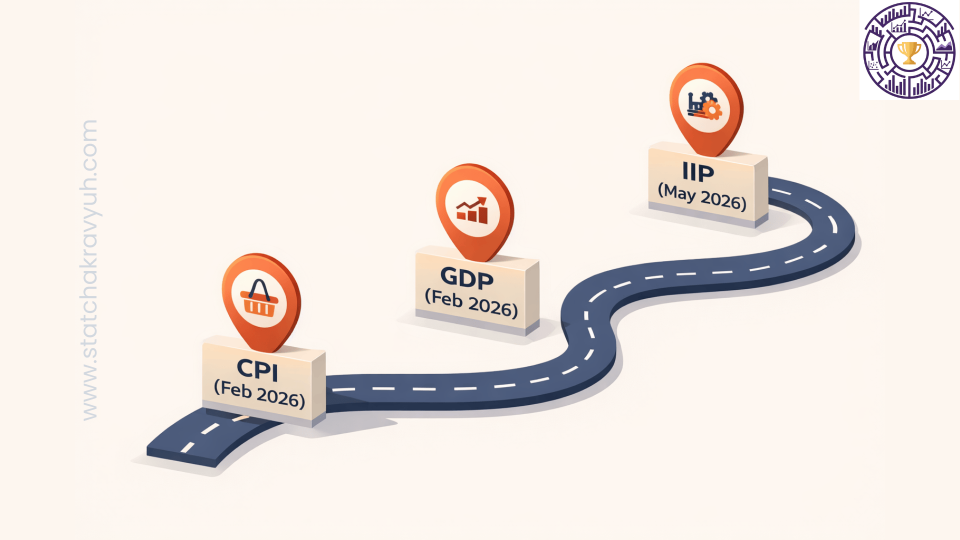
MoSPI has released a roadmap for the new series, targeting a release in early 2026. Here is the snapshot you need to memorize for your objective papers:
| Indicator | Current Base | New Base Year | Expected Release | Key Committee |
| GDP | 2011-12 | 2022-23 | Feb 27, 2026 | ACNAS, (Chair: Prof. B.N. Goldar) |
| CPI | 2012 | 2024 | Feb 12, 2026 | Expert Group (Chair: Ashish Kumar) |
| IIP | 2011-12 | 2022-2023 | May 28, 2026 | TAC on IIP |
You might ask, "Why not 2020 or 2021?" The answer is Stability.
##ISS##
This is where the ISS exam separates the toppers from the crowd. The revision isn't just about changing a date; it's about changing the methodology.
Currently, India uses "Single Deflation"—we just adjust the output value for inflation.
Previously, we assumed the informal sector (small shops, dhobis) grew at the same rate as big corporates. This was a disaster during shocks like Demonetization or COVID.
The CPI basket is getting a makeover based on the Household Consumption Expenditure Survey (HCES) 2022-23.
##NOTE##
For your General Studies (Paper II) and Essay, you need to critique the move. Here are the "Brownie Point" arguments:
Usually, a base year revision follows a Census (Population count). But Census 2021 is delayed. Experts like Pronab Sen argue that without accurate population data, the "multipliers" used to blow up survey data (like HCES) might be wrong, potentially undercounting the urban poor.
Did the informal sector really recover? By moving to a 2022-23 base, some economists fear we might "mask" the scars of the pandemic. If the base year itself is a year of inequality (K-shaped recovery), future growth might look rosy while hiding ground-level distress.
The International Monetary Fund (IMF) recently gave India a "C" grade for some data practices, citing the outdated base year. This 2026 revision is India's direct answer to improve that global credibility.
##CUSTOM | A Special Reward for Serious Aspirants| We originally reserved a 30% discount only for students who attempted both mock papers, but your dedication to reading this full analysis proves you are just as serious about your goal. So we are unlocking this same exclusive benefit for you too. Use coupon code WARRIOR30 to get flat 30% OFF on the UPSC ISS Full Length Series 2026 and start bridging the gap between average and topper marks today.| Use Code WARRIOR30 & Join Now | https://www.statchakravyuh.com/courses/upsc-iss-all-india-test-series-2026-68cd684f8f177064e52de692##
Before you close this tab, make sure you can answer these 3 questions:
Answer: Double Deflation
Answer: ASUSE + PLFS
Answer: HCES 2022-23
Want to know how Inflation is calculated? Read Part 2 here.
Found this helpful? Share this with your ISS study group! And if you are serious about cracking the exam, don't rely on outdated materials. Upgrade your prep with StatChakravyuh.
##LINKS##
 Launch your Graphy